The first, traditionally devoted to the exposition, in three voices, followed by that of relative key, to end with the return of the subject in the soprano until a concluding cadence in the principal key. Note that the entire beginning of the countersubject is surprisingly contained in a simple descending scale.
The second (still in three voices) is exclusively devoted to the exact mirror of the said subject (C as the point of symmetry), which in turn is the subject of an exposition, with the difference that the inverted subject, presented in the alto, is immediately accompanied by the bass. The countersubject of the first part is here also perfectly inverted. The conclusion reaches a cadential group that announces the return of the upright movement, culminating in a short fermata. The third proposes to marry the two forms of the subject (upright and mirror), resorting to the addition of a fourth voice to increase the tension through greater density of writing. This principe of superposition (one-beat stretto) of the two forms sometimes gives rise to shifts (strong beat/weak beat) which destabilize the familiar perception of the subject...
Fugue Turque
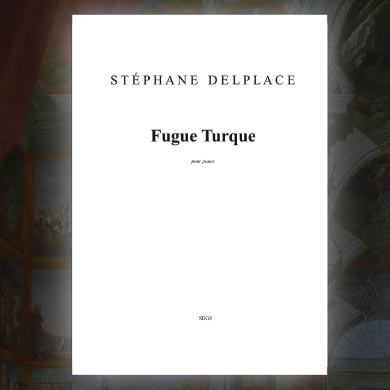
It’s now been 242 years since Mozart wrote his marvelous Sonata in A major, K. 331, with ends with its famous « alla turca » finale. Yet no one, not even Mozart, who was to become increasingly fond of fugue, seems to have attempted to write one based on this incredible theme.
Arcadi Volodos’s brilliant arrangement of this « Turkish March », and Fazil Say’s more jazzy one, long discouraged me from attempting to add a stone to such a sumptuous and, it must be said, (pyro)technically unsurpassable edifice!
But fugal writing offers an opportunity to tackle a completely different type of virtuosity: that of counterpoint.
This fugue, with draws its material (subject) solely from the opening theme, is divided into three parts:
If you would like to purchase the score of « Fugue Turque » (to download), please note that it is available for sale by clicking on the button below. Price: €15